
Apex Trader Funding vs Topstep: Rules and Drawdown
Apex Trader Funding and Topstep compared: evaluation structure, EOD vs trailing drawdown, consistency rules, and account limits, sourced from each firm.
Two firms, two rule sets, and one question that almost nobody asks properly: not "which is easier", but "which one's structure matches how I actually behave when I am down $600 by 10am".
Both firms are sold on their objectives. Both are survived, or not, on their risk controls. This is a comparison of the controls.
Rules change over time. Everything below was checked against each firm's own documentation in September 2026 and is paraphrased rather than quoted. Confirm the current terms for your own account before trading. Educational only, not financial advice.
Key facts, as of September 2026
- Topstep runs one drawdown model, trailing your highest end-of-day balance. Apex lets you choose intraday trailing, which follows peak balance including unrealized gains, or an EOD model closer to Topstep's.
- Topstep's consistency target bites during the evaluation. Apex's bites at the payout request.
- Topstep measures the best day against your profit target. Apex measures it against total profit. The same 50% headline, two different numbers.
- Neither firm imposes a hard daily loss limit on the version most traders start with.
- Both allow many accounts at once, which makes one copied decision look like ten trades in a journal that counts fills.
The one-line difference
Topstep runs one drawdown model: a Maximum Loss Limit that trails your highest end-of-day balance. Apex Trader Funding lets you choose between an Intraday Trailing model, where the floor follows your peak balance including unrealized gains, and an EOD model closer to Topstep's.
That choice is the whole comparison in miniature. On an Apex intraday account, a trade that runs $900 in your favour and gives it all back has permanently raised the floor under you. On Topstep, and on Apex's EOD accounts, it has not, because only the closing balance counts.
For Topstep's side of that in depth, the trailing drawdown explainer covers what moves the floor and when it locks.
Evaluation structure side by side
| Topstep | Apex Trader Funding | |
|---|---|---|
| Evaluation name | Trading Combine | Evaluation account |
| Next stage | Express Funded Account | Performance Account (simulated) |
| Account sizes | 50K, 100K, 150K | 25K up to 150K (250K and 300K retired earlier in 2026) |
| Minimum trading days | Objectives can be met in as few as two | Confirm on your tier's page |
| Drawdown model | Trails highest end-of-day balance | Intraday (peak incl. unrealized) or EOD, chosen at purchase |
| Consistency applies | During the Combine | At payout request |
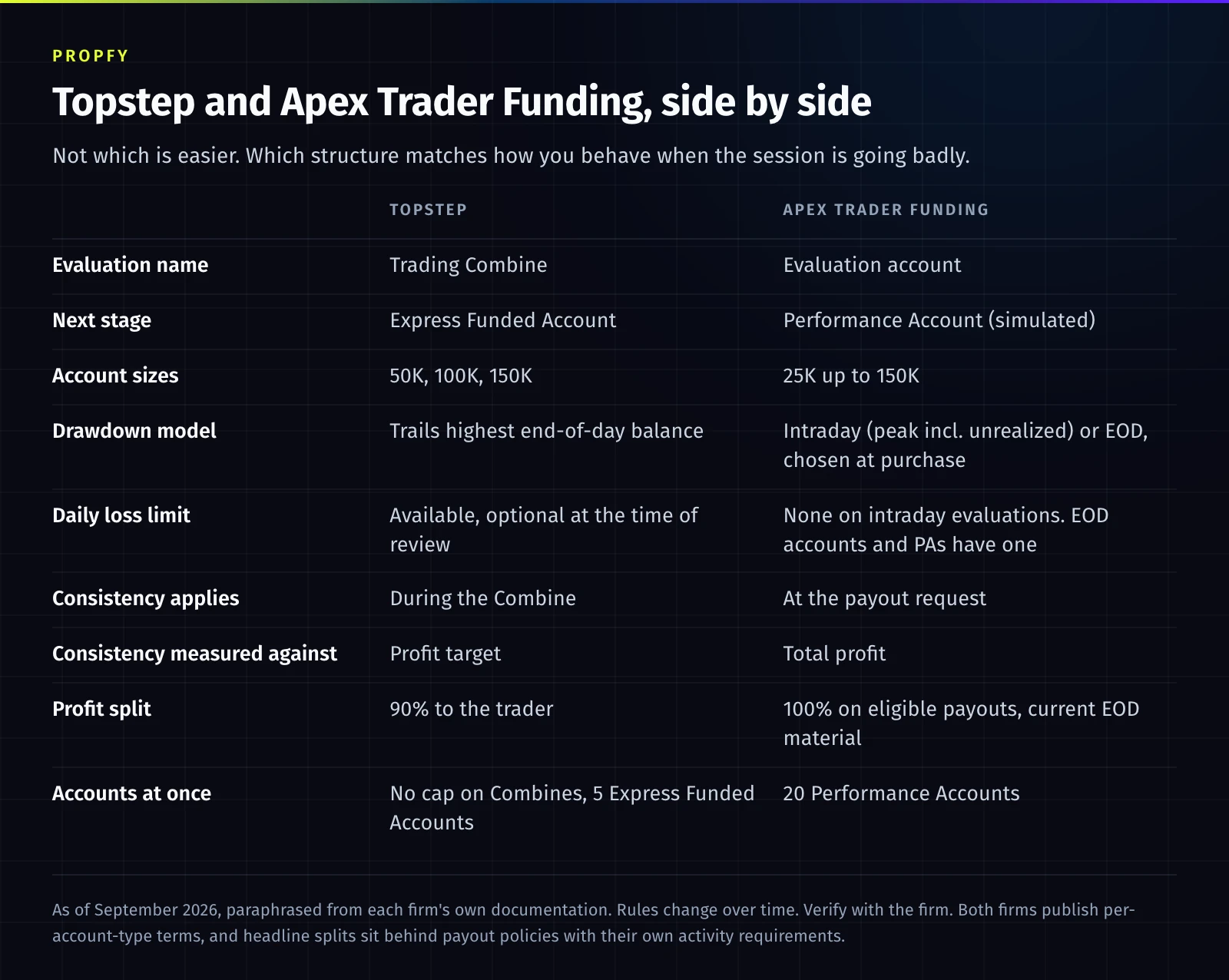
The stage names matter more than they look. Topstep's consistency control bites during the evaluation itself. Apex's bites when you ask for money. Same idea, different moment, and the moment changes what you have to watch and when.
Drawdown mechanics compared
Topstep. The Maximum Loss Limit is a floor that only moves up, tracking your highest end-of-day balance, and it stops moving at a fixed point after which it never moves again. The published starting distances are $2,000 on the 50K, $3,000 on the 100K, and $4,500 on the 150K. Touch the floor and the account is done.
Apex, intraday model. The threshold follows peak balance, and Apex is explicit that peak balance includes unrealized gains, enforced continuously through the session. It never moves down. Their 50K example starts the threshold at $47,500 and documents a threshold stop level of $53,000 once the highest balance reaches $55,000. Those two figures do not come from one clean subtraction, so read the firm's page for your tier rather than deriving it.
Apex, EOD model. The threshold is calculated once per day at market close from your end-of-day balance, then enforced intraday until the next close.
The practical consequence: on Apex intraday, your true room can shrink during a session in which you made nothing. On Topstep and on Apex EOD, your room is fixed from the open until the close. If you scale out of runners, or hold through drawdown inside a trade, that difference is not academic. It is the difference between a floor you can plan around at 9:30 and one you have to recompute after every green print.
Daily loss limits
Topstep. A Daily Loss Limit is available and, at the time of review, optional in the Trading Combine and the Express Funded Account. It is a risk-control choice, not the same thing as the Maximum Loss Limit, and confusing the two is a common and expensive mistake.
Apex. No daily loss limit on intraday trailing drawdown evaluations. EOD accounts and Performance Accounts do have one. Reaching it liquidates open positions and pauses trading until the next session open at 6pm ET, and Apex states clearly that this does not fail the account.
| Topstep | Apex Trader Funding | |
|---|---|---|
| Is there one | Available, and optional at the time of review in the Trading Combine and the Express Funded Account | None on intraday trailing evaluations. EOD accounts and Performance Accounts have one |
| What it is not | The Maximum Loss Limit. Confusing the two is a common and expensive mistake | The threshold. The daily limit ends a session, the threshold ends the account |
| Reaching it | A risk control you chose to switch on | Liquidates open positions and pauses trading until the next session open at 6pm ET, and does not fail the account |
So on both firms, the version of the account most traders buy can leave the daily brake entirely to the trader. That is a bigger deal than the drawdown difference, because a daily limit is the only rule that stops a bad session before it becomes an account-ending one. Our daily loss limit guide covers where to set your own.
Consistency rules, and the denominator nobody reads
This is where the two firms differ most, and the difference is in what the percentage is measured *against*.
Topstep's Consistency Target compares your single best day to your profit target. Their parameters page states the best day should stay below 50% of the profit target, and exceeding it raises the target rather than ending the account.
Apex's consistency rules compare a single day to your total profit at the time of a payout request. As of September 2026 their help centre documents a 30% version tied to legacy Performance Account payouts, applying until the sixth payout or transfer to live, and a 50% version for current EOD and intraday accounts framed against profit since the last payout they cleared.
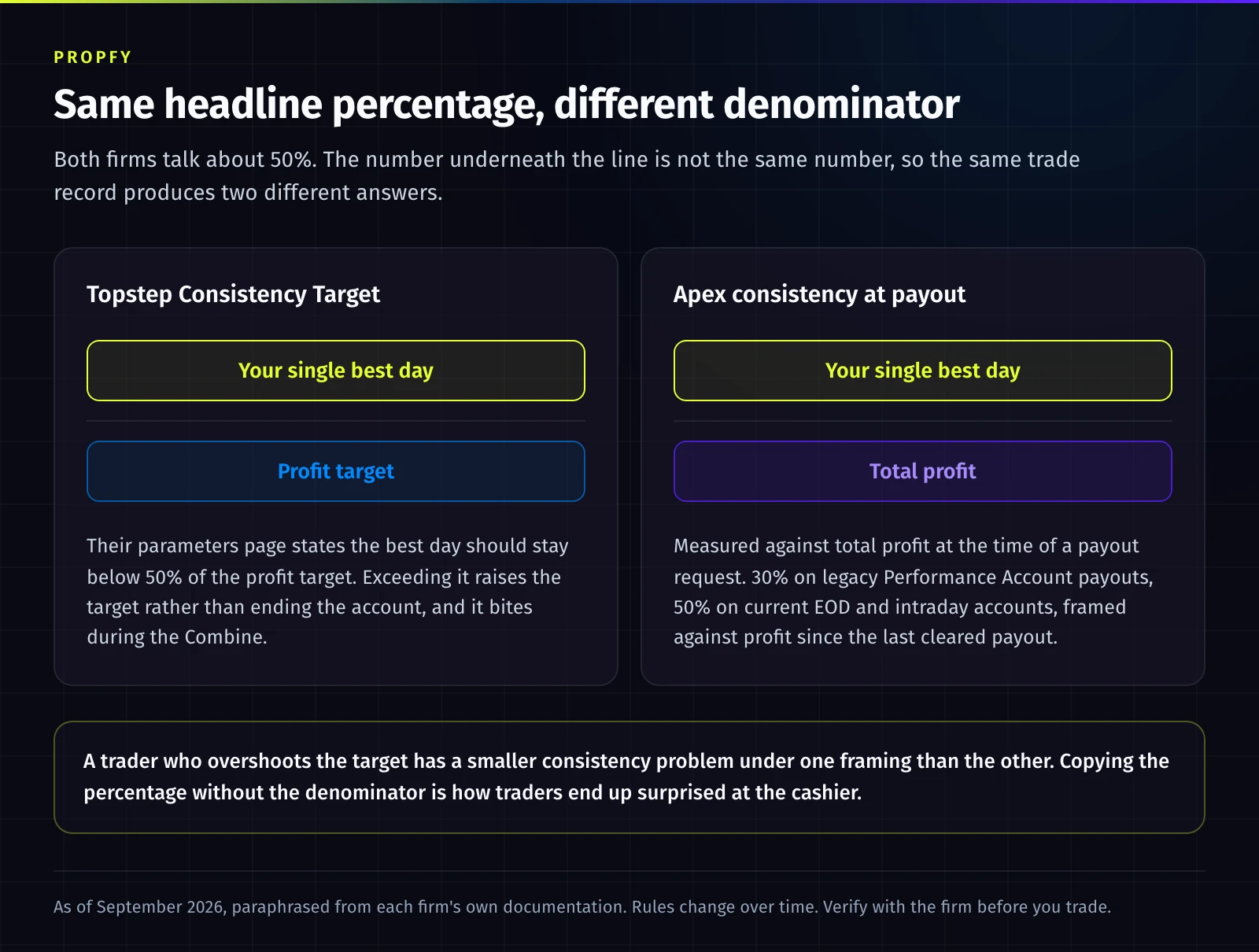
Read those denominators again. "50% of the profit target" and "50% of total profit" produce different numbers on the same trading record. A trader who overshoots the target has a smaller consistency problem under one framing than the other. They are two different rules with the same headline percentage, and copying the number without the denominator is how traders end up surprised.
The concept, stripped of firm specifics, is in prop firm consistency rules explained.
Account count and platform
Topstep. Up to 20 new Trading Combines can be started per month, with no cap on how many you run concurrently, and up to 5 active Express Funded Accounts at one time (a figure Topstep notes can vary with participation in its other programs). Execution runs on TopstepX, built by ProjectX, and Rithmic-connected platforms such as R|Trader Pro and the tools that plug into it.
Apex. Up to 20 Performance Accounts active at the same time, across sizes and across both drawdown models.
Both firms therefore support running many accounts at once, which creates the same tracking problem at both: if you mirror one decision across ten accounts, you have made one decision, not ten trades. Your risk multiplies, your behavioural sample does not. A journal that counts every copied fill separately will quietly flatter or distort every statistic you care about.
Payouts and profit split
Topstep. Traders keep 90% of profits, with Topstep taking 10%, up to the maximum allowed by the selected payout policy. For the Express Funded Account, requesting a payout requires five winning days of $150 or more in net P&L, not necessarily consecutive, and the maximum per request is capped as a percentage of the reward balance with a dollar ceiling that varies by policy.
Apex. Their current EOD payout material documents a 100% split on eligible payouts, a $500 minimum per request, and eligibility limited to profit above the safety net. Historic and legacy account generations have carried different splits, so check the article that matches your account.
Two notes. First, headline splits mean nothing until you clear a payout policy's activity requirements, and both firms have them. Second, a payout is not the thing that keeps an account alive. The drawdown floor is.
Which fits which trader
Not a verdict, a decision framework. Answer these from your own trade log, not from memory.
Do you hold winners through pullbacks? Apex's intraday model raises the floor on unrealized highs you never keep. Topstep's, and Apex's EOD version, do not. If you scale out or manage runners, the EOD-style model gives you room that matches how you trade.
Do you need a hard daily brake, or will you build one? Neither firm imposes one on the version most traders start with. If your own record shows sessions that ran away from you, choose the account type that has a daily limit, or write your own number and treat breaking it as a failure even on a green day.
Where does your best day sit? If your equity curve is one big day and a lot of noise, both firms' consistency rules will catch you, but Topstep's catches you during the evaluation and Apex's catches you at the cashier. Decide which delay you can live with.
How many accounts are you honestly going to manage? Twenty is a number, not a plan.
The part that decides which one fits you
Here is one trader's data, offered as illustration and nothing more. Mo, who built Propfy, ran the numbers on his own live stretch across two weeks. Win rate on the trade after a win: 55%. Win rate on the trade after a loss: 24%. Trades nine through eleven of a day: 0%. Two sessions landed near or past his own loss cap, one at minus $2,134. The model was the same in all of them.
If a split like that exists in your record, then the question "which firm is easier" is the wrong question. The tighter rule set is not automatically the harder one to keep. A daily loss limit that pauses your session at a fixed number is a constraint if your problem is opportunity, and a lifeline if your problem is the trade you take at 10:47 to get it back.
Your rule-following record predicts which structure suits you better than the headline numbers do. That is a process-over-P&L judgement, and you can only make it if you have been logging rule breaks separately from losses.
Journaling either one
The mechanics differ, the tracking does not. Whichever firm you are on, three numbers belong in front of you before each entry:
- Distance to the drawdown floor, now. On Apex intraday, recompute after any trade that printed a new equity high, kept or not. On Topstep and Apex EOD, it is fixed until the close.
- Distance to the daily limit, the firm's if it has one, yours if it does not.
- Whether the last trade was a loss, because that is the single flag most likely to predict the quality of the next one.
If you are running both firms at once, which plenty of traders do, keep them in one place with each account's own rule set attached. Comparing your Apex record to your Topstep record only means something if both are measured against the limits that actually applied. For the Topstep side specifically, our Trading Combine guide covers the routine, and FTMO vs Topstep covers the other comparison traders ask about most.
FAQ
Is Apex or Topstep harder?
They are hard in different places. Apex's intraday model tightens your room on unrealized highs; Topstep's floor only moves on closing balances. Topstep applies its consistency target during the evaluation; Apex applies consistency at the payout request. Which one is harder depends on your holding style and where your best day sits relative to everything else.
Does Topstep's drawdown trail intraday?
Topstep's Maximum Loss Limit tracks your highest end-of-day balance rather than your best intraday print, and it only moves up. Confirm the behaviour for your specific account type in Topstep's current documentation, since account types differ.
Can I trade Apex and Topstep at the same time?
Nothing in either firm's rules stops you from holding accounts at both, and many traders do. The practical limit is attention: two rule sets, two floors, and two consistency denominators to keep straight in the same session.
Which has the better profit split?
Apex documents a 100% split on eligible payouts for its current EOD accounts; Topstep documents 90% to the trader. Both figures sit behind payout policies with their own activity requirements and per-request caps, so the split alone is not a comparison.
Sources checked (September 2026)
- Topstep Trading Combine parameters
- Topstep Consistency Target
- Topstep payout policy
- Apex Trader Funding help centre
- Apex Intraday Trailing Drawdown Explained
- Apex Daily Loss Limit Explained
About Propfy
Propfy is a trading journal for Topstep, Apex Trader Funding, and other futures prop firms. It attaches each account's own rule set to that account, tracks live distance to the drawdown floor and daily loss limit, counts one copied decision once across mirrored accounts, and surfaces the behavioural splits that decide whether a rule set fits you.
It will not block a trade or close your platform, and nothing can promise you an outcome. It makes the numbers visible while there is still time to use them.