
Best Trading Journal for Prop-Firm Futures Traders
What a trading journal needs to cover for futures prop accounts, and how the main options compare on rules tracking, multi-account sync, and behaviour data.
Most trading journals answer one question well: what did I make. That question is already answered by your broker statement, for free, in less time.
The question a prop account actually poses is different. It is: how close was I to the number that ends this account, and what was I doing in the minutes before I got close? A journal that cannot answer that is a receipt with charts on it.
This is a buying guide organised around that distinction. It is written by the team behind Propfy, which is one of the options in the category, so read the criteria first and decide whether they are the right ones before you read anything else.
Key facts
- A prop account poses a different question from a brokerage account: not what did I make, but how close was I to the number that ends this account.
- The drawdown floor is a mechanic, not a note. Trailing on peak balance, trailing on closing balance and sitting static produce three different numbers on the same trade log.
- Copy-trading breaks the statistics. One decision mirrored across eight accounts is one decision and eight times the risk, and most journals log it as eight trades.
- Behaviour fields beat outcome fields. Win rate after a loss against win rate after a win is the cheapest diagnostic in trading, and almost nobody computes it.
- This guide is written by the team behind Propfy, which is one of the options in the category. Read the criteria first and decide whether they are the right ones.
What a prop-first journal needs that a general journal does not
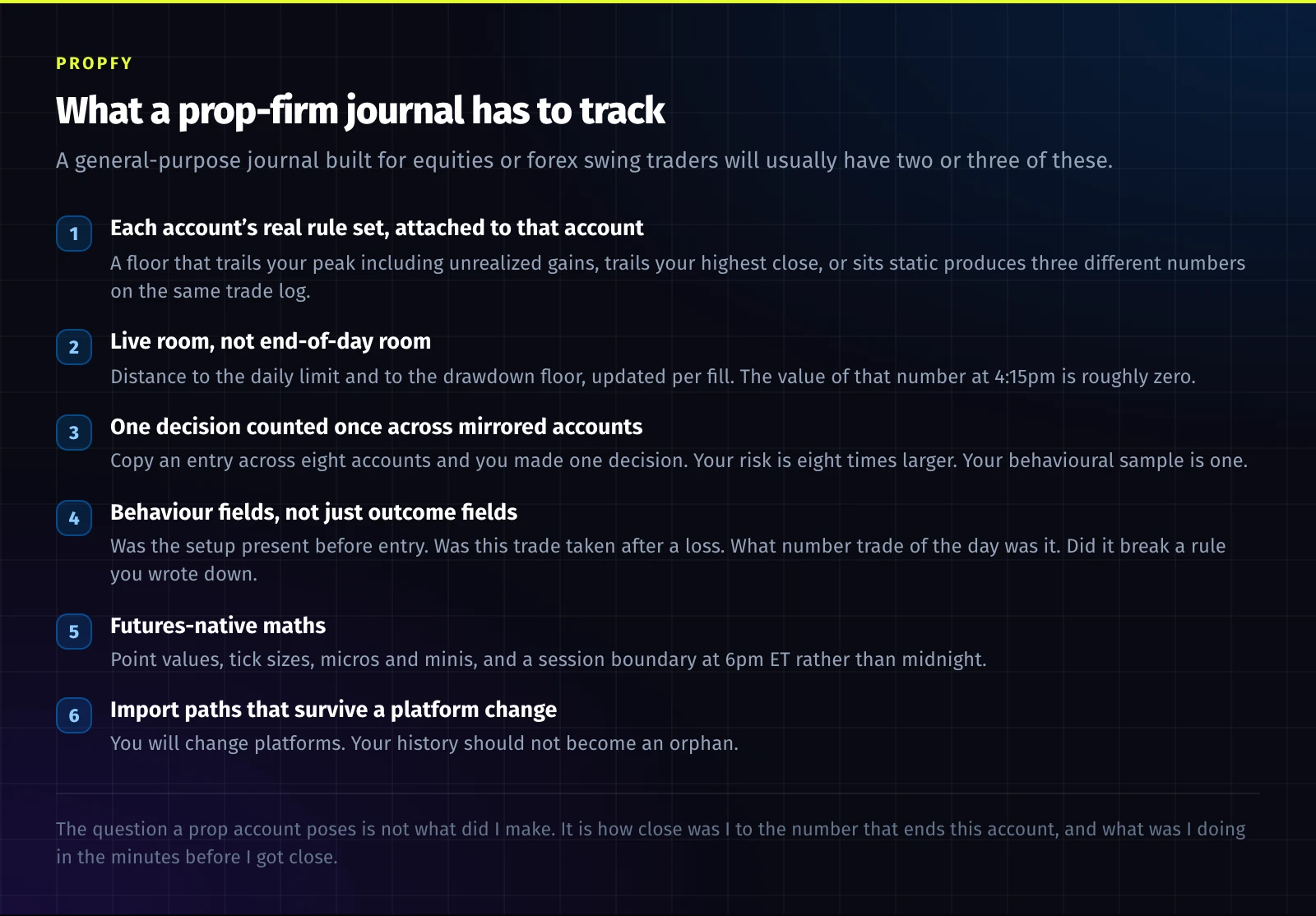
Six things. A general-purpose journal built for equities or forex swing traders will usually have two or three of them.
1. Each account's real rule set, attached to that account. A drawdown floor is not a preference, it is a mechanic that differs by firm, by account type, and sometimes by the day. A journal that stores "max loss: $2,000" as a note is storing trivia. It needs to know whether the floor trails your peak balance including unrealized gains, trails your highest closing balance, or sits static, because those produce three different numbers on the same trade log.
2. Live room, not end-of-day room. Distance to the daily limit and distance to the drawdown floor, updated per fill. The value of that number at 4:15pm is roughly zero.
3. One decision counted once across mirrored accounts. More on this below, because it is the most commonly broken statistic in the category.
4. Behaviour fields, not just outcome fields. Was the setup present before entry, yes or no. Was this trade taken after a loss. What number trade of the day was it. Did it break a rule you wrote down.
5. Futures-native maths. Point values, tick sizes, micros and minis, session boundaries at 6pm ET rather than midnight. A journal that treats a futures contract like a share position will get your risk-per-trade wrong.
6. Import paths that survive a platform change. You will change platforms. Your history should not become an orphan.
If you want to see those fields written out before you buy anything, our futures trading journal template is the paper version. Plenty of traders have worked through evaluations on a spreadsheet, and a spreadsheet is a completely reasonable place to start.
The sync question
Automatic import is the difference between a journal you keep for three weeks and one you keep for a year. Manual entry loses to fatigue, always, and it loses fastest on the days you most need the data, because a day with eleven trades in it is a day you do not feel like typing up.
The platforms that matter for futures prop accounts, roughly in order of how often they come up:
- TopstepX, which is where Topstep execution largely lives
- Rithmic, which sits under a long list of front ends including R Trader Pro and several third-party charting platforms
- Tradovate, used directly and as a rails layer by several firms
- NinjaTrader, both as a platform and as a broker
- MT4 and MT5, mostly for traders who arrived from the FX side
- CSV, which is the universal fallback and should always be available
Before you subscribe to anything, check the actual connection for your firm and your platform, and check whether it imports fills or only closed trades. A journal that imports closed positions cannot tell you your maximum adverse excursion, which means it cannot tell you how close an open position took you to a threshold. We have platform-specific write-ups for Tradovate trade history, MT4 and MT5, and TopstepX with multiple accounts.
Multi-account and copy-trade handling
This one deserves its own section because it silently corrupts every statistic downstream.
Traders on Apex Trader Funding can run up to 20 performance accounts at once. Topstep places no cap on concurrent evaluation accounts and allows up to five active Express Funded Accounts. So mirroring is normal, and most journals handle it exactly wrong.
If you copy one entry across eight accounts, you made one decision. Your risk is eight times larger. Your behavioural sample size is one. A journal that logs eight trades will tell you that you took 40 trades this week when you made five decisions, that your win rate is computed on a sample eight times more confident than it is, and that your "trades per day" discipline metric is meaningless.
What you want is both views, kept separate: P&L per account, real and unmodified, because each account has its own floor and its own payout cycle, and decisions counted once, because that is the number your behaviour data has to be built on. Ask any vendor this question directly. Most have not thought about it.
Behaviour data vs performance data
Performance data describes the outcome. Behaviour data describes the decision that produced it. Almost every journal in the category does the first well.
Here is what the second looks like in practice, using one trader's numbers. Mo, who built Propfy, went through his own live record across a two-week stretch. The headline was unremarkable: 29.6% win rate, 5.4 trades a day, profit factor 1.08. The same model run in simulation over the same period: 61.8% win rate, 2.2 trades a day, profit factor 1.95.
Then he sorted the live trades by what preceded them.
- Win rate on the trade after a win: 55%
- Win rate on the trade after a loss: 24%
- Trades nine through eleven of a day: 0%
- Two sessions at or past his own daily loss cap, one at minus $2,134
- Longest losing streak: 11
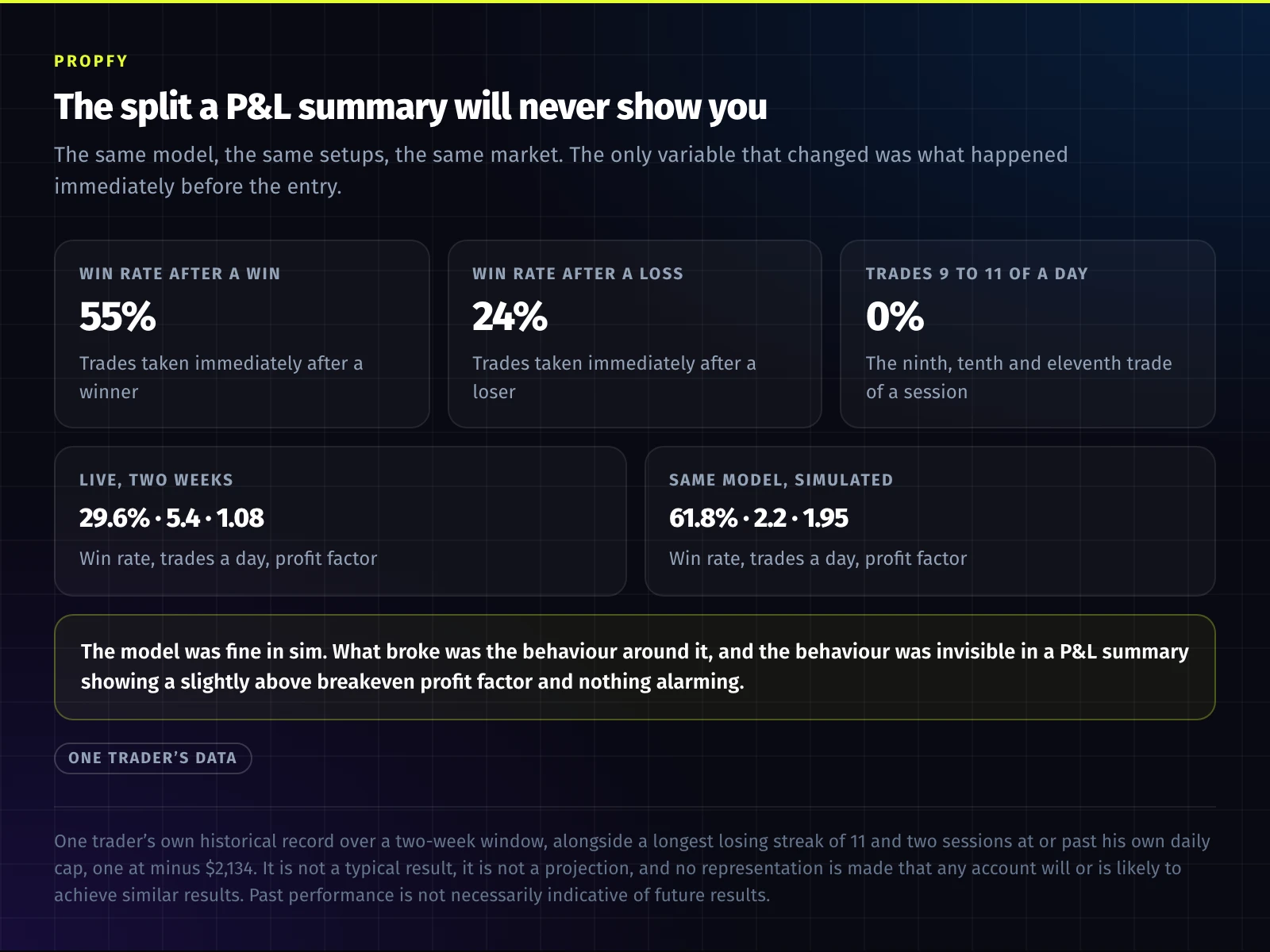
That is one trader's data and it proves nothing about yours. What it demonstrates is the *shape* of the finding: the model was not the problem. The model was fine in sim. What broke was the behaviour around it, and the behaviour was invisible in the P&L summary, which showed a slightly-above-breakeven profit factor and nothing alarming.
Here is the buying criterion that falls out of that. Pick a journal by asking whether it can produce those five lines from your own data, without you exporting to a spreadsheet and writing formulas. If it cannot tell you your win rate after a loss, it cannot tell you the thing most likely to be ending your accounts.
Rule-proximity tracking
The other half of the same idea. Two numbers, live:
Room to the daily limit. Simple subtraction, but only if the journal knows whether your firm measures realized or unrealized P&L, and only if it knows your session boundary.
Room to the drawdown floor. Not simple, because the floor moves. On an account whose threshold follows peak balance including unrealized gains, a winner you gave back has permanently tightened your room. Traders who track their opening balance are working from a number that expired at 9:47am.
And the most common misreading in the category: room to the floor is not room to lose. Open profit moves both sides of that calculation at once. A journal that recomputes it per fill is doing arithmetic you will not do correctly under pressure.
How the main options compare
Rather than a feature table that goes stale in a quarter, here are the four shapes the category comes in and what each is good at.
Broker and firm dashboards. Free, accurate on P&L, live on the rules that the firm itself enforces. They tell you nothing about your decisions and nothing across firms. Necessary, not sufficient.
General-purpose trading journals (Tradervue, TraderSync, Tradezella and similar). Strong analytics, broad broker support, mature tagging and reporting. Built for a wide audience, which means prop rule mechanics are usually a text field rather than a computed number, and copy-trade deduplication is rarely a first-class concept. Check the current feature list yourself rather than trusting any comparison post, including this one. We have a longer look at that trade-off in our Tradezella alternative write-up.
Platform-bundled journals (Journalytix and tools that ship with a broker or platform). Convenient, tightly integrated with one execution stack, and usually tied to it. Good if you are certain you are staying on that stack.
Prop-first journals, of which Propfy is one. Built around the firm rule set as a computed object and around behaviour fields as first-class data. The trade-off runs the other way: narrower asset coverage, less appeal if you also trade equities and options.
There is no universal answer in that list. There is an answer for a futures trader running three evaluation accounts across two firms, and a different one for a swing trader with a single brokerage account.
Pricing shapes across the category
Do not compare monthly figures without comparing what they gate. The shapes:
- Subscription tiers with limits on account count, history depth, or number of synced connections. The account-count limit is the one that bites prop traders, so read it before the headline price.
- One-time or lifetime, which shifts the risk to you if development stops.
- Firm-bundled, included with an evaluation purchase. Free until you change firms.
- Free tiers, usually capped on trade volume or history retention.
Check prices on the vendor's own page on the day you buy. Every number in a comparison article is out of date, this one included.
What to check before switching
- Export format. Can you get your history out as CSV, with fills rather than summaries. If not, you are renting your own data.
- Historical import. Can you bring the last year in, and does it map to your accounts correctly.
- Account-count limits on the tier you are actually buying.
- Whether it counts copied fills once. Ask explicitly.
- Whether the drawdown maths matches your firm's model. Trailing on peak balance and trailing on closing balance are different products.
Evaluation stage vs Results stage
The tracking that matters changes when the account does. Every firm names the two stages differently, but the split is the same: the account you are still working through, and the account you trade after it.
On an evaluation account, the pressure is the objective and the clock. The metrics that matter are trade count discipline, consistency-rule share of your best day, and whether you widened your criteria under pressure. Most evaluation records die of impatience.
On a Results-stage account, the pressure is protecting something that already exists. The metrics shift to drawdown room, days without a rule break, and the size of your worst day relative to your average green day. Most of those accounts die on a single session.
| Evaluation account | Results-stage account | |
|---|---|---|
| The pressure | The objective and the clock | Protecting something that already exists |
| Metrics that matter | Trade count discipline, the consistency-rule share of your best day, whether you widened your criteria under pressure | Drawdown room, days without a rule break, the size of your worst day against your average green day |
| How most of them end | Of impatience | On a single session |
A journal that only has one mode will serve you well in one of those two stages.
FAQ
Do I really need a dedicated journal, or is a spreadsheet enough?
A spreadsheet is genuinely enough for one account and a handful of trades a day. It starts failing at multiple accounts, at copy-trading, and at any calculation the firm does differently from your approximation, which is usually the drawdown.
What is the single most useful metric for a prop trader?
Win rate and average size on the trade immediately after a loss, compared to after a win. It is the cheapest diagnostic in trading and almost nobody computes it.
Should my journal sync automatically or should I type trades manually?
Manual entry has a real benefit: it forces you to look at each trade. It also has a fatal flaw: you stop doing it exactly when the data would be most useful. The workable compromise is automatic sync for the numbers and manual entry for the judgement fields, which is what most serious journals now do.
Can one journal handle several prop firms at once?
It can if it stores rules per account rather than per user. If a tool assumes every account has the same limits, running two firms in it will give you one accurate account and one that quietly misreports your room.
About Propfy
Propfy is a trading journal for Topstep, Apex Trader Funding, MyFundedFutures, and other futures prop firms. It syncs fills or imports CSV, attaches each account's own rule mechanics to that account, tracks live room to the drawdown floor and the daily limit, counts one copied decision once across mirrored accounts, and computes the behavioural splits (after a loss, after a win, by trade number, by session) that a P&L-only journal cannot.
It will not block a trade or close your platform, and nothing can promise you an outcome. It shows you the numbers while they are still actionable, which, if the problem is behaviour rather than strategy, is most of the work.