
Trailing Drawdown vs Static Drawdown, Explained
The mechanical difference between trailing and static drawdown, why it changes your position sizing, and how to know your real room before the next trade.
Ask a room of prop traders what their drawdown is and you will get dollar figures. Ask them what moves it and the room gets quiet.
That is the gap this article closes, because the dollar figure is the least useful half of the answer. Two traders with identical trade logs, identical account sizes, and identical drawdown allowances can end a month in completely different positions, purely because one firm measures the floor against a peak and the other measures it against a line.
Rules change over time. Every firm-specific detail below was checked against that firm's own documentation in September 2026 and is paraphrased rather than quoted. Confirm the current terms for your own account type. Educational only, not financial advice.
Key facts, as of September 2026
- Static asks how far below a fixed line you are. Trailing asks how far below your best you are. Under a trailing rule, making money moves the floor up behind you.
- Trailing comes in two variants. End-of-day updates once from your closing balance. Intraday follows the peak, and on Apex's intraday model that peak explicitly includes unrealized gains.
- That difference decides whether you can lose room without losing money. On intraday trailing you can. On end-of-day trailing and static you cannot.
- Every trailing floor locks eventually, and after it locks it is a static floor. Knowing where yours locks is the difference between sizing for a cage and sizing for a cushion.
- Room to the floor is not room to lose. Open profit moves both sides of that calculation at once.
Two different questions a drawdown rule can ask
Static: how far below a fixed line are you?
Trailing: how far below your best are you?
Everything else is implementation. But those two questions produce opposite incentives, and the second one has a property that catches almost everyone: the floor moves while you are winning.
Under a static rule, making money buys you room. Under a trailing rule, making money moves the goalposts up behind you, and once they move they do not come back down.
Static drawdown, mechanically
The floor is set from a fixed reference, usually the starting balance, and stays there.
FTMO's Maximum Loss on its futures and 2-step products is the clearest example of the family: their documentation frames it as a limit below which account equity must not drop, anchored to the initial simulated capital. Their 5% maximum daily loss is likewise recalculated from a fixed percentage of initial capital rather than from a peak.
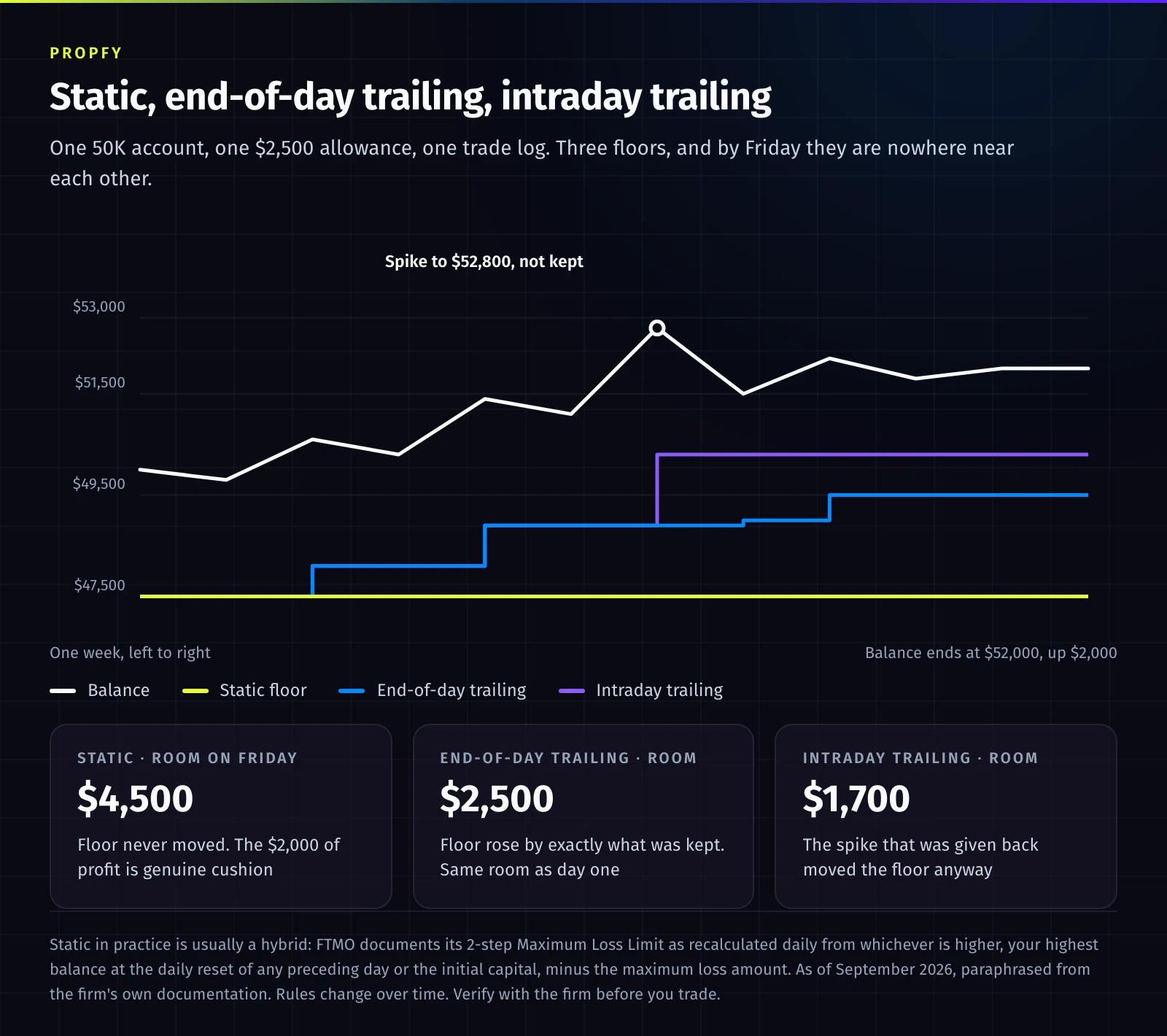
Except it is not purely static, and this is the first place traders go wrong. FTMO documents the 2-step Maximum Loss Limit as recalculated daily from whichever is higher, your highest balance at the daily reset of any preceding day or the initial capital, minus the maximum loss amount. That is a static floor with an end-of-day trailing floor stacked on top of it. Their 1-step product is documented as end-of-day trailing outright.
So "static" in practice usually means "static until you are profitable, then it trails". Our FTMO drawdown rules explainer walks the specific numbers.
What static gets you: predictability. Your room at 9:30 is your room at 15:30. You can size a whole week from one number.
Trailing drawdown, mechanically
The floor follows your equity peak. Two variants, and the difference between them is worth real money.
End-of-day trailing. The floor updates once, from your closing balance. Topstep's Maximum Loss Limit works this way: it tracks the highest end-of-day balance, only ever moves up, and stops moving permanently at a fixed point. Apex Trader Funding's EOD accounts are calculated once per day at market close and then enforced intraday until the next close.
Practical consequence: a session where you print +$1,800 at 10:40 and close flat leaves your floor exactly where it was. A session where you grind +$400 and keep it raises the floor by $400, permanently.
Intraday trailing. The floor follows the peak *balance*, and on Apex's intraday model that peak explicitly includes unrealized gains, enforced continuously. The +$1,800 you never closed has raised your floor by $1,800 anyway.
That single difference decides whether the following is true for you: you can lose room without losing money. On intraday trailing, yes. On end-of-day trailing and static, no.
Topstep's version, in detail, is in the trailing drawdown explainer.
Where each shows up
As of September 2026, paraphrased from each firm's documentation:
| Firm / account type | Drawdown model |
|---|---|
| Topstep, Trading Combine and Express Funded Account | Trails highest end-of-day balance, up only, locks at a fixed point |
| Apex Trader Funding, intraday evaluations | Trails peak balance including unrealized gains, enforced continuously |
| Apex Trader Funding, EOD accounts | Calculated at market close from EOD balance, enforced intraday |
| FTMO, 2-step | Higher of initial capital or highest daily-reset balance, minus the max loss amount |
| FTMO, 1-step | End-of-day trailing |
| Earn2Trade, Gauntlet Mini | EOD drawdown rising with daily profit until it reaches the starting balance, then fixed |
Note how many rows say "end of day". The intraday variant is the exception rather than the rule, which is exactly why traders who move to one from an EOD firm get caught. They carry a mental model that used to be correct.
The sizing consequence
Here is the part that changes how you trade rather than how you talk.
Take two accounts, both 50K, both with a $2,500 allowance. Trader A is on static, Trader B is on end-of-day trailing.
Week one, both make $2,000 and keep it.
- Trader A's floor: unchanged. Room is now $4,500, the original $2,500 plus the $2,000 of profit sitting above it.
- Trader B's floor: up $2,000. Room is still $2,500.
Same trades, same P&L, and by Friday one of them has 80% more room than the other. Trader B has to keep sizing as though it were day one, forever, until the floor locks.
Now run it the other way. Both take an early large win, say $1,500 in one session.
- Trader A now has a cushion and can survive a bad stretch without approaching the line.
- Trader B has locked in a tighter cage. The good day did not buy safety, it bought obligation.
This is why "get ahead early so you have breathing room" is decent advice at one firm and wrong at another. Under a trailing rule, the only thing that buys breathing room is reaching the lock point. Position sizing has to reflect that: contract sizing off stop distance rather than off account size is the practice that survives both models.
The lock point
Every trailing floor stops trailing eventually, and after it stops it is a static floor. Knowing where yours locks is the difference between sizing for a cage and sizing for a cushion.
| Firm / account type | Where the floor stops trailing |
|---|---|
| Topstep | A fixed point, after which the Maximum Loss Limit never moves again |
| Apex, intraday evaluations | Published as a threshold stop level: $53,000 on their 50K example, reached when the highest balance hits $55,000. Not one clean subtraction from the $47,500 start, so read the firm's page for your tier |
| Apex Performance Accounts | Starting balance plus $100, which puts a 50K account's permanent floor at $50,100 |
| Earn2Trade, Gauntlet Mini | Rises with profit until it reaches the starting balance, then stops |
Notice the pattern in the last two: the floor locks at or just above where you started. Once that happens, every dollar of profit above it is genuine cushion for the first time. Traders who quit an account three days before the lock point are quitting the hardest part of the account.
The single most common misreading
Room to the floor is not room to lose.
They look identical and they are not, because open profit moves both sides of the calculation at once.
Say you are $1,200 above your floor on an intraday-trailing account and you are holding a position that is currently +$500. Your room to the floor reads $1,700 on the equity line. But that $500 has already lifted your floor if it printed a new peak. Give it back and you are not at $1,700 minus $500. You are at $1,200 minus whatever the peak moved.
On an end-of-day trailing account the same mechanic has a slower fuse. Your room is honest all day, and then at the close your floor jumps by exactly what you kept, so tomorrow's room is a different number than the one you have been using all afternoon.
Anyone recomputing this in their head, mid-session, in a trade, is going to get it wrong sometimes. The frequency of getting it wrong correlates with how the session is going, which is precisely the wrong correlation.
And it is separate from your daily loss limit, which many traders conflate with the drawdown. One ends a day, the other ends the account. Both belong in your premarket plan as distinct numbers, which is the subject of our daily loss limit guide.
What this costs when you do not track it live
One trader's data, offered as illustration and nothing more. Mo, who built Propfy, pulled his own live record over a two-week stretch. Win rate on the trade after a win: 55%. Win rate on the trade after a loss: 24%. Trades nine through eleven of a day: 0%. Two sessions ran at or past his own loss cap, one closing at minus $2,134.
Connect that to the drawdown mechanic and you get the real failure mode. The trader who does not know whether their floor is trailing or static right now is, structurally, the same trader who takes the next entry without checking room. Both are the same omission: acting on a number they have not looked at recently, because looking would be inconvenient at that exact moment.
The 24% is not a strategy problem. The setups were the same ones that produced 55% in calmer conditions. What changed was that the decision got made without the inputs, and the drawdown number is one of the inputs.
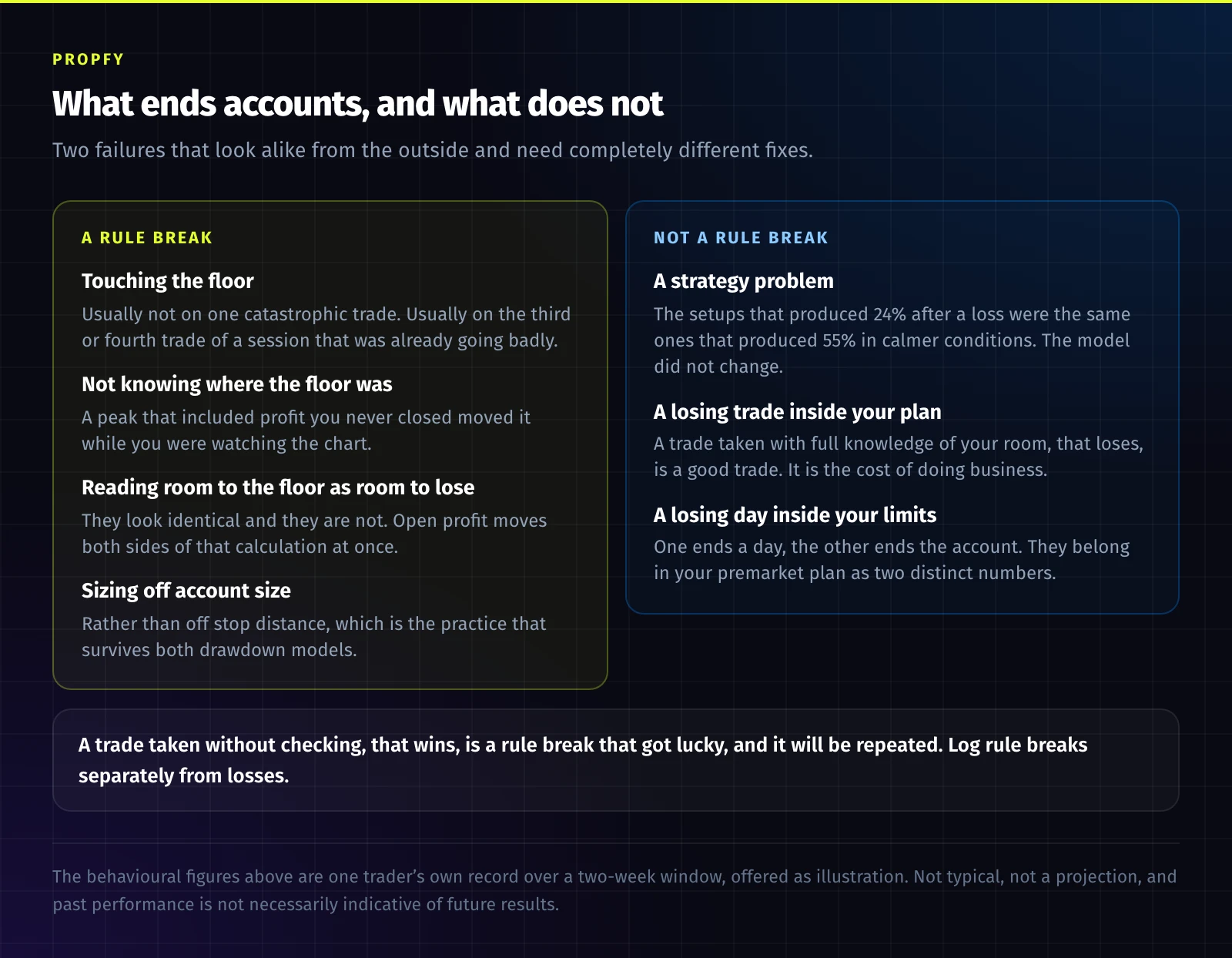
This is the process-over-P&L argument in its most concrete form. A trade taken with full knowledge of your room, that loses, is a good trade. A trade taken without checking, that wins, is a rule break that got lucky, and it will be repeated.
How to track real room without doing arithmetic mid-session
Four things worth automating or writing down.
1. Which model you are on, in writing. Trailing intraday, trailing end-of-day, or static. Write it on the same page as your trade plan. If you run accounts at two firms, write both.
2. Your current floor, recomputed after every peak. On intraday trailing, after any trade that printed a new equity high, whether or not you kept it. On EOD trailing, at the close.
3. Your lock point, and your distance to it. This is a milestone worth tracking deliberately, because it is the moment your account changes character.
4. Room to the floor and room to the daily limit as two separate lines. Never one blended "risk left" figure. They fail differently and they need different responses.
A spreadsheet handles this for one account. It stops handling it at three accounts across two firms with different models, which is roughly the point where most prop traders end up.
FAQ
Is trailing drawdown worse than static drawdown?
Not worse, tighter after you become profitable. Static rewards early gains with permanent cushion; trailing converts early gains into a higher floor. Which one suits you depends on whether your equity curve climbs steadily (trailing is manageable) or moves in bursts with give-back (trailing leaves less room).
Does trailing drawdown include unrealized profit?
It depends entirely on the firm and account type. Apex's intraday model explicitly includes unrealized gains in the peak. Topstep's Maximum Loss Limit tracks end-of-day balances instead. Check yours before you assume, because this is the single most consequential detail in the rule.
When does a trailing drawdown stop trailing?
At a lock point defined by the firm, usually tied to the profit target or the starting balance. Apex documents Performance Accounts locking at starting balance plus $100; Earn2Trade documents the Gauntlet Mini drawdown rising until it reaches the starting balance. After the lock, the floor is static and never moves again.
Why did my drawdown get tighter on a day I made nothing?
Almost certainly an intraday-trailing account where a position went into profit and came back. The peak, including unrealized gains, raised the floor; the round trip returned your balance but not your room.
Do I need to track drawdown if my firm shows it in the platform?
The firm's number is authoritative and you should use it. The reason to track it yourself is history: the platform shows you today, and your journal shows you the pattern of how close you get, on which days, after which kinds of session. That pattern is what you can actually change.
Sources checked (September 2026)
- Topstep Maximum Loss Limit
- Apex Intraday Trailing Drawdown Explained
- Apex EOD Drawdown Explained
- FTMO trading objectives
- Earn2Trade drawdown types
About Propfy
Propfy is a trading journal for Topstep, Apex Trader Funding, FTMO, and other futures prop firms. It stores each account's drawdown model as a computed rule rather than a note, recalculates your live room to the floor and to the daily limit per fill, tracks your distance to the lock point, and records whether you checked those numbers before entering.
It will not block a trade or close your platform, and nothing can promise you an outcome. It puts the number that ends accounts in front of you while there is still time to act on it.