
MyFundedFutures Consistency Rule: The 50/40 Split
How MyFundedFutures' evaluation and payout-stage consistency rules work, what the percentage is measured against, and how to track your best-day share live.
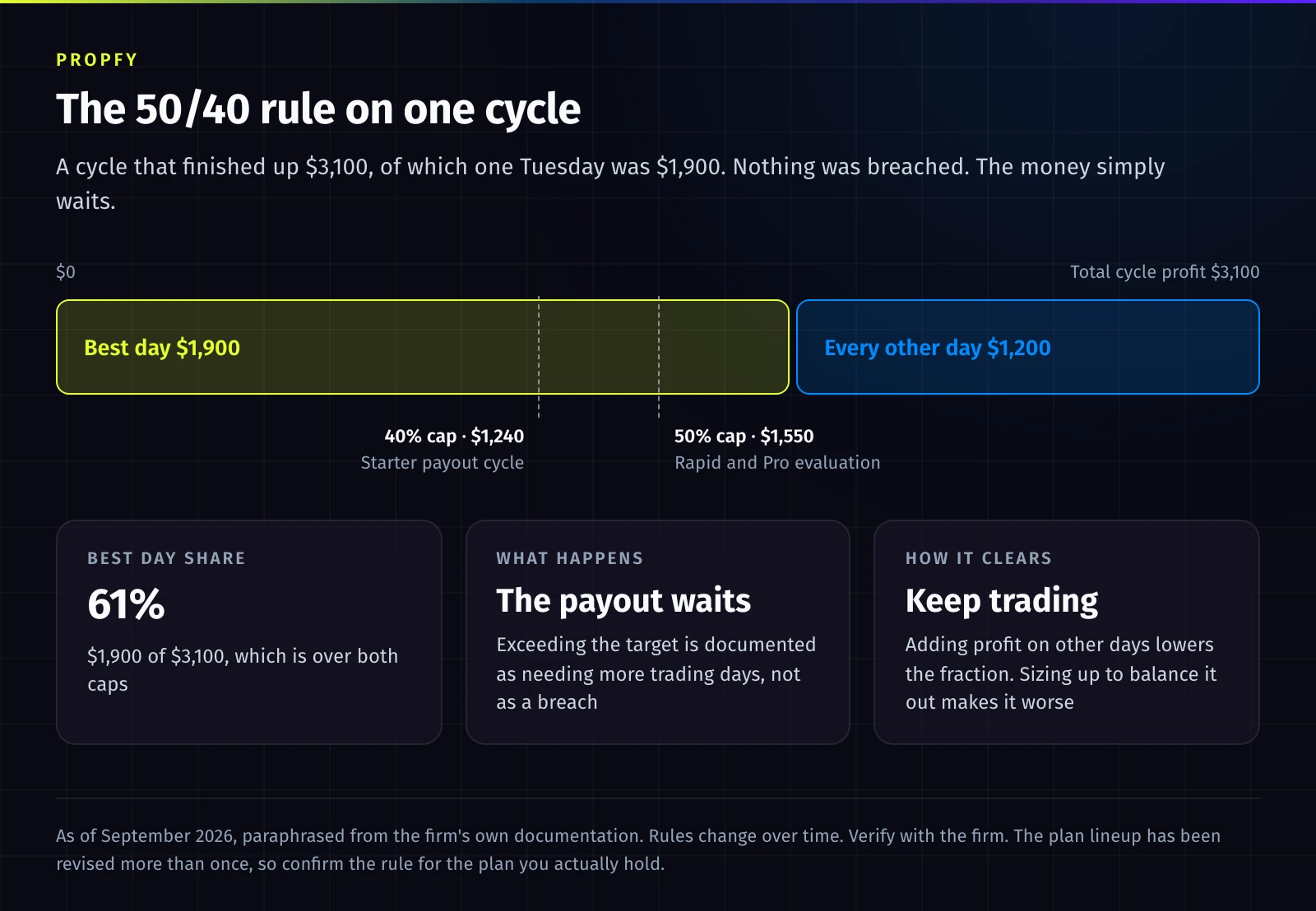
A trader finishes an evaluation cycle up $3,100. Objectives met, no breaches, nothing dramatic. Then the payout request stalls, because one Tuesday accounted for $1,900 of it.
Nothing was broken. No rule was violated in the way traders usually mean. The consistency rule simply looked at the shape of the profit rather than the size of it, and said: not yet.
Rules change over time. Everything below was checked against MyFundedFutures' own help centre in September 2026 and is paraphrased rather than quoted. Their plan lineup has been revised more than once, so confirm the current rule for the plan you actually hold. Educational only, not financial advice.
Key facts, as of September 2026
- One number decides it: your single best day's profit as a share of your total profit for the window.
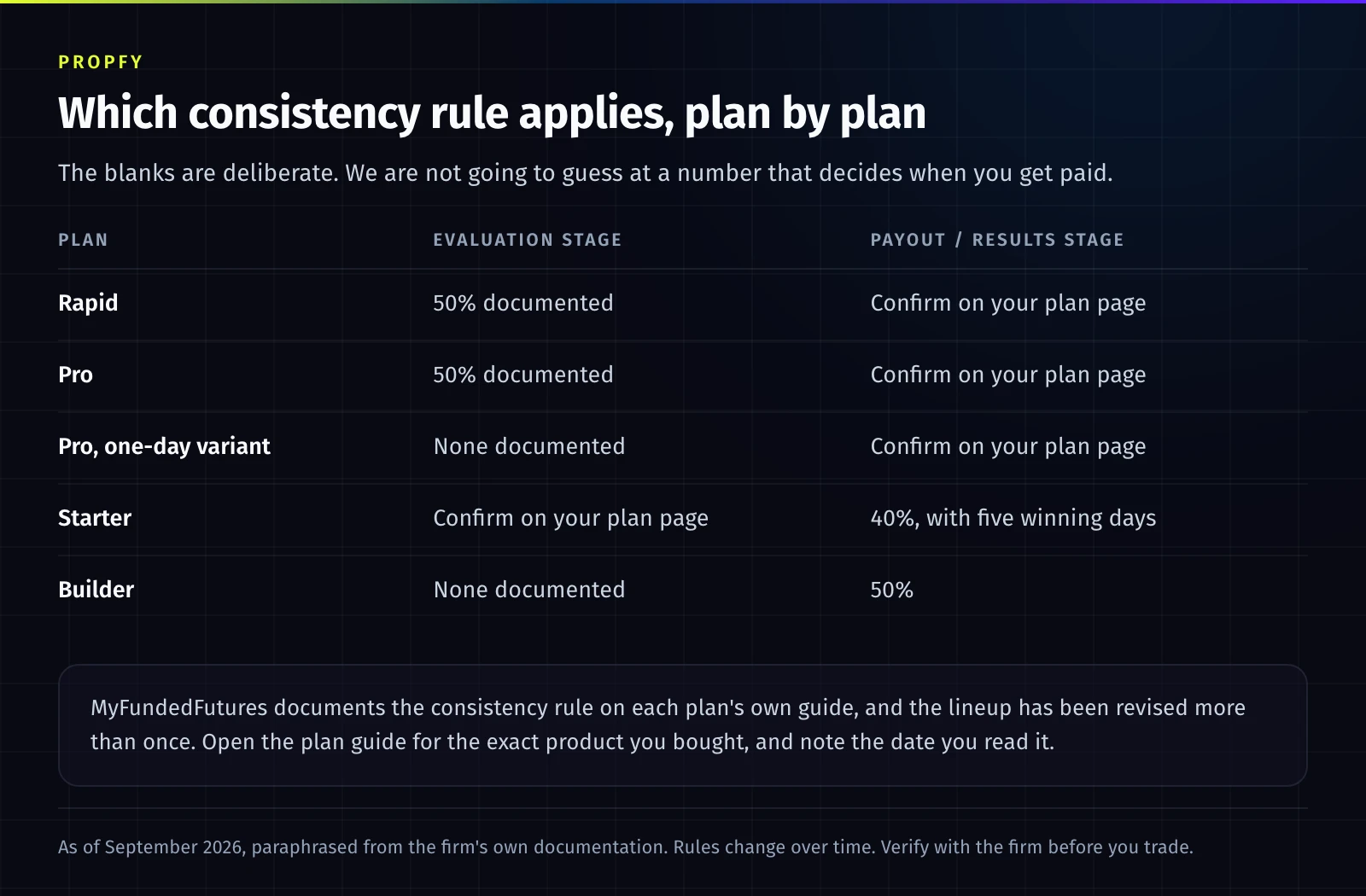
- 50% on the evaluation stage of the Rapid and Pro plans. The one-day variant of Pro is documented with no consistency rule at all.
- 40% on the Starter plan's payout cycle, alongside five winning days. The Builder plan is documented with no evaluation rule and 50% at payout.
- Measured against total profits, not against the profit target. That is a different sum from the one Topstep traders are used to.
- Going over is not a breach. It delays the money until further trading days bring the fraction back down.
What the consistency rule is actually checking
One number, measured two ways depending on the stage:
Your single best day's profit, as a share of your total profit.
That is it. Not your win rate. Not how many days you traded. Not whether you followed your plan. The firm takes the largest green day in the window and divides it by everything you made in that window. If the result is above the cap, the money waits.
The rule is not asking "did you make enough". It is asking "did you make it the same way more than once".
For the concept across firms, including how the denominator changes what the same headline percentage means, see prop firm consistency rules explained.
The 50% evaluation rule
As of September 2026, MyFundedFutures documents a 50% consistency rule on the evaluation stage of its Rapid and Pro plans: no single day's profit should exceed 50% of your total evaluation profits. Their one-day variant of the Pro plan is documented as having no consistency rule at all.
Two details do most of the work here.
It measures against total profits, not against the target. This is the distinction that trips up traders coming from Topstep, whose consistency target compares the best day to the profit target instead. Same 50% headline, different denominator, different arithmetic on identical trade records. If you have an evaluation record from another firm in your head, retire the number and recompute.
Exceeding it does not end the account. MyFundedFutures is explicit that going over the 50% target is not a breach. The remedy is more trading days: keep adding profit until the best day's share falls back under the cap. The rule delays you. It does not disqualify you.
That second point is worth sitting with, because the emotional response to "I broke the consistency rule" is usually panic, and panic produces exactly the trading that made the ratio bad in the first place.
The 40% rule at the payout stage
The 40% figure attaches to the payout side rather than the evaluation. MyFundedFutures documents the Starter plan as requiring five winning days with 40% consistency before a withdrawal: no single day's profit may exceed 40% of your total simulated profits during the payout cycle. If your best day is over the line, withdrawals pause until further trading brings the percentage back under it.
The winning-day minimums are small by design (documented in the region of $100 to $300 per day depending on account size), which tells you what the rule measures. It is not a profitability test. It is a *repeatability* test, applied before money moves.
Their Builder plan is documented differently again: no consistency rule during evaluation, and a 50% rule at the payout stage. And some plans drop the consistency requirement entirely once you are past the evaluation.
Plan by plan, as documented
| Plan | Evaluation stage | Payout stage |
|---|---|---|
| Rapid | 50% documented | Confirm on your plan page |
| Pro | 50% documented | Confirm on your plan page |
| Pro, one-day variant | None documented | Confirm on your plan page |
| Starter | Confirm on your plan page | 40%, with five winning days |
| Builder | None documented | 50% |
The blanks are deliberate. MyFundedFutures documents the consistency rule on each plan's own guide, and the lineup has been revised more than once. We are not going to guess at a number that decides when you get paid. Open the plan guide for the exact product you bought, and note the date you read it.
Sources: the MyFundedFutures consistency rule article and the evaluation parameters overview.
Why the rule exists
The rule prices variance.
A trader whose profit comes from one enormous session and a flat scatter around it has produced a result the firm cannot distinguish from a lucky size-up. A trader whose profit comes from eleven modest green days has produced something with a shape to it. The second record is cheaper to underwrite, because it is more likely to repeat.
From the trader's side, the rule lands on an exact behaviour: the outsized recovery day. Not the disciplined big win on an A+ setup that happened to run, though the rule catches that too. The oversized day that follows a losing stretch, taken at three times normal size, because the account was down and the trader wanted it back in one trade.
Which is to say the consistency rule is a discipline rule wearing a maths costume.
How a single oversized day sneaks past unnoticed
Here is the mechanic that catches people.
The rule is a ratio, and early in a cycle the denominator is tiny. Day one, up $600. Day two, up $200. Your best day is now 75% of total profit. That is fine, because nobody is requesting a payout on day two, and further trading fixes it automatically.
Then the cycle gets long, the ratio drifts down to something comfortable, and you stop thinking about it. Week three, a session runs, you finish up $1,400 on a cycle total of $3,000. You are back over the line and you did not notice, because you last checked the number when it did not matter.
Nobody recomputes a running percentage by hand at 4pm on a green day. That is the actual failure mode: the rule is trivially simple and almost never tracked live.
What this has to do with your worst behaviour
One trader's data, offered as illustration and nothing more. Mo, who built Propfy, pulled his own live numbers across a two-week stretch. Win rate on the trade after a win: 55%. Win rate on the trade after a loss: 24%. Trades nine through eleven in a day: 0%. Two sessions ran near or past his self-imposed loss cap, one finishing at minus $2,134.
Now look at what that pattern does to a consistency ratio. The days that blow the numerator open are rarely the calm ones. They are the sessions where size went up because the previous day was red, or the previous three trades were red. Those sessions produce both the outsized loss days that end accounts and, when they happen to work, the outsized win days that stall payouts.
The same behaviour, sampled twice. That is why the consistency rule and the drawdown rule are not two separate problems. They are one problem with two invoices, which is also why traders who obsess over the strategy and ignore the process keep meeting both. More on that pattern in why prop traders lose their accounts.
Track the percentage as you trade, not after the cycle
Four things worth having in front of you.
1. Your running best-day share, updated at every session close. Best green day divided by cumulative profit for the current cycle. One number. If it is drifting toward the cap, you know before it is a problem rather than at the cashier.
2. What today would do to that ratio if you closed now. This is the version that changes behaviour, because it turns an abstract rule into a live decision. A day that is already your best of the cycle by a wide margin is a day to consider finishing rather than pressing.
3. Rule breaks logged separately from losses. They are different failures. A losing day inside your plan is the cost of doing business. A $1,900 day taken at four times your normal size is a rule break that happened to be green, and if you only log P&L you will file it as a good day and repeat it.
4. Your own cap, set inside the firm's. If the firm says 40%, work to 30%. The buffer costs nothing on the days you do not need it.
Position sizing is the lever underneath all four. If your size is a function of stop distance and a fixed dollar risk rather than of how you feel about the last trade, oversized days mostly stop happening on their own. Contract limits and how they interact with account rules are covered in prop firm account trade limits, and the payout mechanics at another firm, for comparison, in Topstep payout rules explained.
FAQ
Does breaking the MyFundedFutures consistency rule end my account?
No. MyFundedFutures documents exceeding the evaluation consistency target as something that requires more trading days rather than a breach. At the payout stage, an over-cap best day pauses the withdrawal until further profit brings the ratio back under the threshold.
Is the MyFundedFutures rule 50% or 40%?
Both figures appear, at different stages and on different plans. As of September 2026 their documentation describes 50% on Rapid and Pro evaluations, 40% on the Starter plan's payout cycle, and 50% at the Builder plan's payout stage. Check the guide for your specific plan, since the lineup has been revised.
Is the percentage measured against my profit target or my total profit?
Against total profit for MyFundedFutures. That differs from firms that measure the best day against the profit target instead, which produces a different number on the same record.
How do I fix a best day that is over the cap?
Keep trading normally. The ratio is a fraction, and adding profit on other days lowers it without you having to do anything clever. Sizing up to "balance it out" makes the numerator problem worse, not better.
Does the consistency rule apply after I move past the evaluation?
It depends on the plan. Some MyFundedFutures plans drop it at that point; others apply a version of it to each payout cycle. Confirm on your own plan page rather than assuming.
Sources checked (September 2026)
- MyFundedFutures consistency rule
- Understanding evaluation parameters at MyFundedFutures
- MyFundedFutures payout policy overview
About Propfy
Propfy is a trading journal for MyFundedFutures, Topstep, Apex Trader Funding, and other futures prop firms. It keeps a running best-day percentage per payout cycle, tracks live distance to each account's drawdown floor and daily loss limit, logs rule breaks separately from losses, and shows you the behavioural splits behind your outsized days.
It will not block a trade or close your platform, and nothing can promise you an outcome. It makes the ratio visible on the day you could still do something about it.