
Apex Trader Funding Rules: Drawdown and Consistency
How Apex Trader Funding's trailing threshold, EOD daily loss limit, and consistency rules actually work, with the account-size math and what ends an evaluation.
Most traders on an evaluation account can recite the profit target and nothing else. They know they need $3,000 on a 50K account. Ask them where their threshold sits right now, after this morning's open trade went $700 in their favour and came back, and the answer is a shrug.
That gap is the whole article. Apex Trader Funding's rules are not complicated, but they are *live*. The number that ends an account moves while you are looking at the chart.
Rules and account parameters change over time. Everything below was checked against Apex Trader Funding's own help centre in September 2026 and is paraphrased, not quoted. Confirm the current terms for your own account type with the firm before you trade. Educational only, not financial advice.
Key facts, as of September 2026
- Two drawdown models, and you choose one when you buy: Intraday Trailing, which follows peak balance including unrealized gains, and End-of-Day, set once from your closing balance.
- On a 50K intraday evaluation the threshold starts at $47,500 and stops trailing at a published $53,000, reached once the highest balance hits $55,000.
- No daily loss limit on intraday evaluations. EOD accounts and Performance Accounts have one, and reaching it pauses the session rather than failing the account.
- Consistency is applied at the payout request, not as an evaluation breach: a 30% version on legacy Performance Account payouts, a 50% version on current EOD and intraday accounts.
- Up to 20 Performance Accounts at once. Every figure here can change, so confirm your own on the firm's site.
What you are actually buying from Apex Trader Funding
There are two stages and two drawdown models, and traders routinely mix them up.
The stages. You buy an evaluation account. Meet the objectives without breaking a rule and you move to a Performance Account (PA), which Apex runs as a simulated account. Payouts are requested from the PA.
The models. Apex documents an Intraday Trailing Drawdown model and an End-of-Day (EOD) Drawdown model, and you pick one when you buy. They are not two labels for the same thing. They enforce the floor at different moments, and one of them has a daily loss limit while the other does not.
If prop-firm evaluations in general are new to you, start with what a prop firm evaluation is and come back.
The trailing threshold, and where it locks
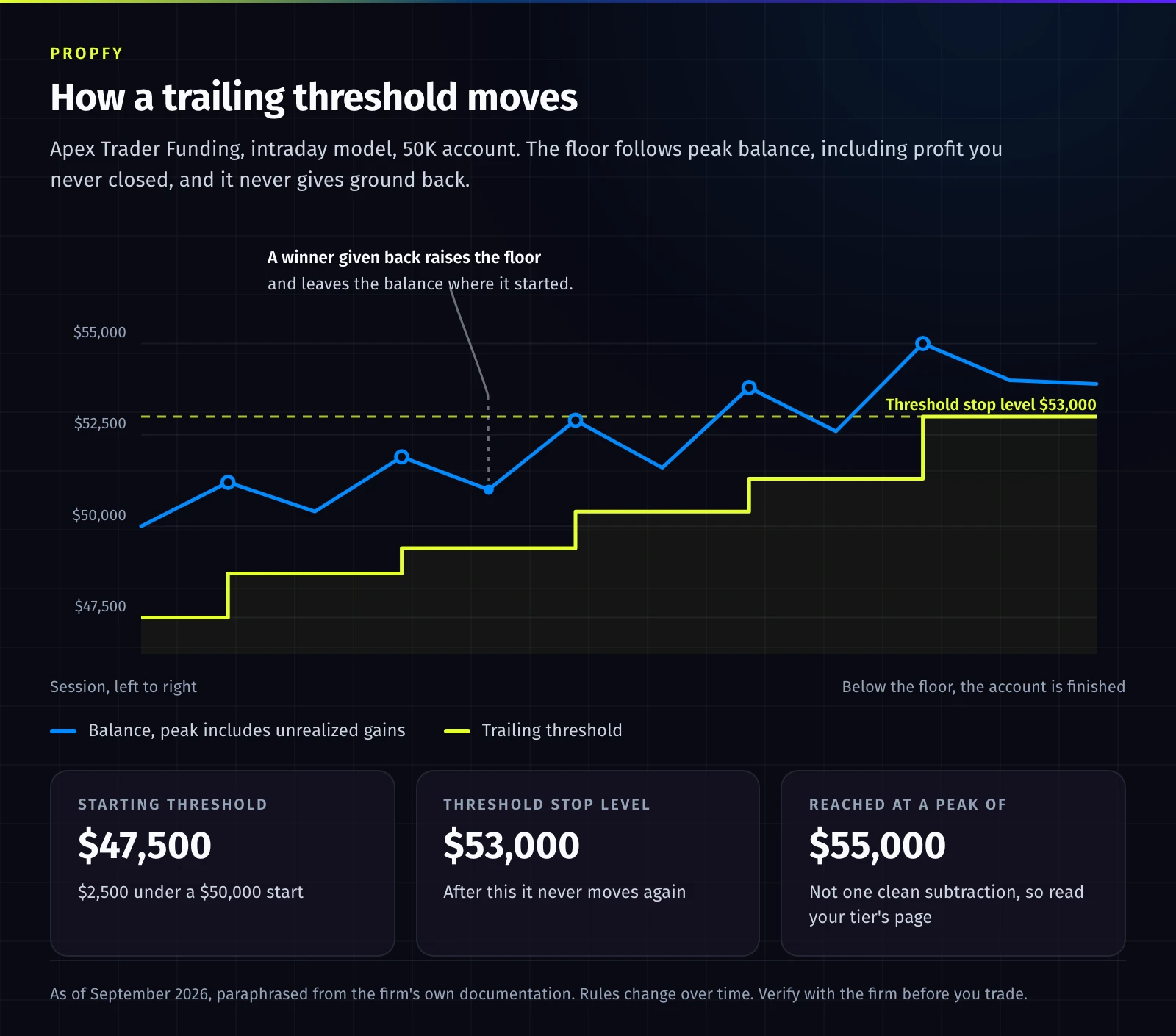
On the intraday model, the threshold is a floor underneath your account that follows your peak balance, and Apex's documentation is explicit that peak balance includes unrealized gains. The floor moves up as your equity prints new highs. It never moves back down. If your balance touches or drops below it at any moment, positions are liquidated and the account is finished.
That "unrealized" word is the expensive part. A trade that goes $900 in your favour and gives it all back has raised your floor by $900 and left your balance where it started. You are now $900 tighter than you were at the open, having made nothing.
On the EOD model, the same idea runs on a once-a-day clock. Apex calculates the threshold at market close from your end-of-day balance, so intraday spikes do not move it. Once set, it is enforced intraday, which means the floor is still live during the session, it just stops climbing on every tick.
Where it stops trailing. On an intraday evaluation, Apex publishes the lock point in terms of the profit-target balance. Their 50K example: the threshold starts at $47,500, which is $2,500 under the $50,000 starting balance, and the threshold stop level is $53,000, reached once the highest balance hits $55,000. Note that those two numbers are not a single clean subtraction, which is exactly why you should read the Intraday Trailing Drawdown explanation for your account size rather than deriving your own lock point.
On Performance Accounts the lock behaves differently again. Apex documents the intraday threshold stopping at starting balance plus $100, so on a 50K PA the floor settles at $50,100 and stays there. Practically, that turns your trailing drawdown into a static one at a level slightly above where you started.
Daily loss limits by account type
This is the single biggest structural difference between the two models, and it surprises people who switched.
Intraday evaluations have no daily loss limit. Apex says so plainly. Nothing stops you at $800 down, or $1,600 down. The only floor is the threshold, and the threshold is the end of the account, not the end of the day.
EOD accounts and Performance Accounts have a daily loss limit. Reaching it flattens your open positions and pauses trading for the rest of the session. Apex is clear that this does not fail the account: it resets at the next session open, 6pm ET. On a PA, the daily loss limit scales as the account moves up profit tiers, alongside the contract limit.
Read those two paragraphs again and notice the asymmetry. On the model with no daily limit, a bad session has no brake except the one you build. On the model with a daily limit, the firm has already decided what your worst day looks like. If you have ever had a session run away from you, you are choosing between "the firm stops me" and "nobody stops me", and that is a decision about your own behaviour, not about drawdown mechanics.
| Account type | Daily loss limit | What happens when you reach it |
|---|---|---|
| Intraday trailing evaluation | None documented | Nothing stops you. The threshold is the only floor, and it ends the account rather than the day |
| EOD account | Yes | Open positions are flattened and trading pauses until the next session open at 6pm ET |
| Performance Account | Yes, scaling with your profit tier | Open positions are flattened and trading pauses until the next session open at 6pm ET |
Our prop firm daily loss limit guide covers the personal circuit-breakers that sit inside either version.
The consistency rule on payouts
Apex applies consistency at the payout stage, not as a hard rule that ends an evaluation. The principle is the same one every futures firm uses: no single day may account for too large a share of your profit when you request money.
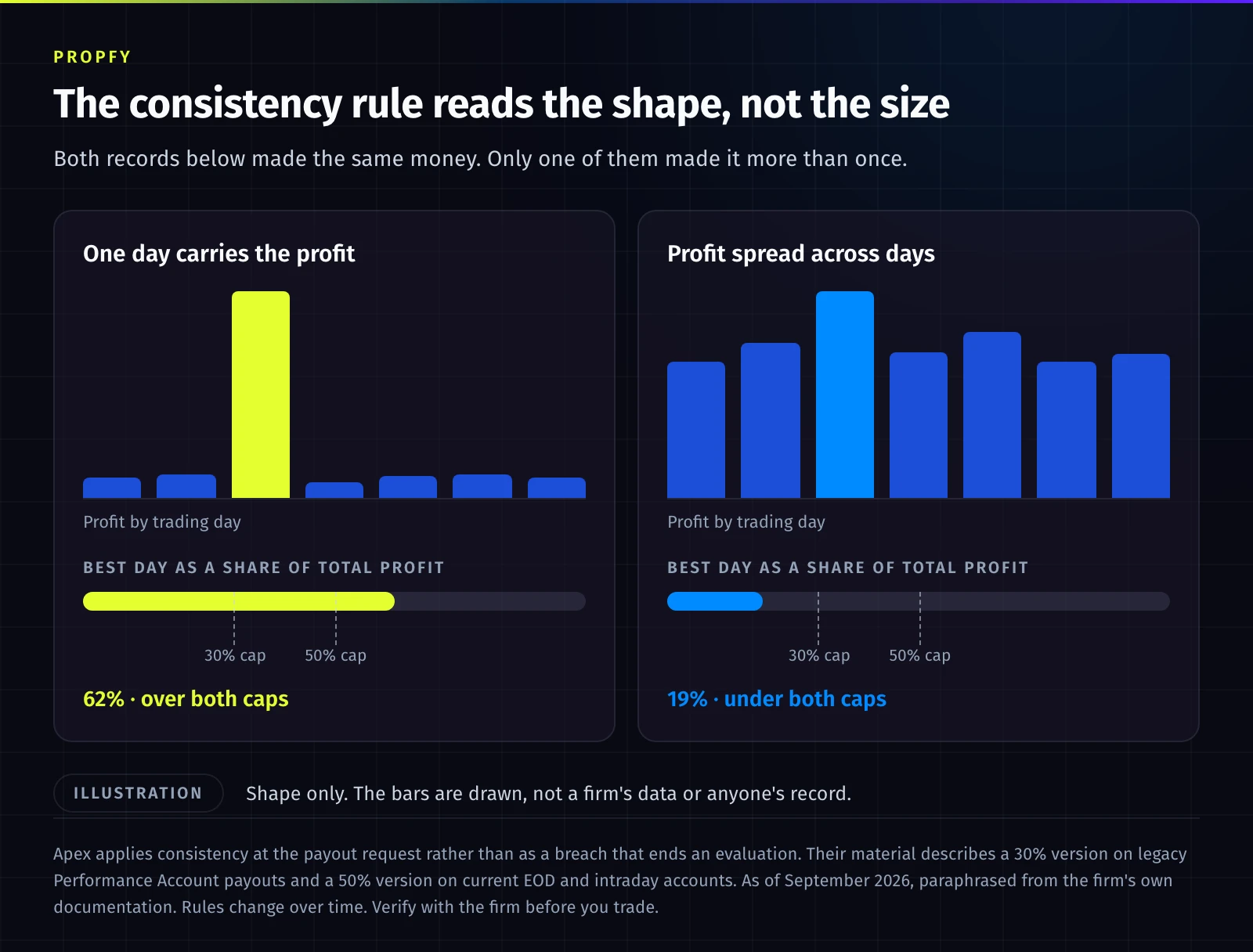
Where it gets messy is that Apex's help centre documents more than one generation of account. As of September 2026 their material describes a 30% rule on legacy Performance Account payouts, framed as no single trading day exceeding 30% of the total profit balance at the time of the request, applying until the sixth payout or until the account moves to live. Their current EOD and intraday material describes a 50% version, framed as no single profitable day accounting for 50% or more of total profit since the last payout they cleared.
Do not take a number off a forum. Open your own dashboard, find your account generation, and read the payout article that matches it. Apex also documents a separately named 30% Negative P&L Rule (Maximum Adverse Excursion), which is a different rule about drawdown inside trades rather than about day-to-day profit distribution. We are not going to paraphrase its mechanics here because the detail matters and it is worth reading from the source.
If the concept itself is fuzzy, prop firm consistency rules explained walks through what these caps are actually measuring.
Account sizes and profit targets at a glance
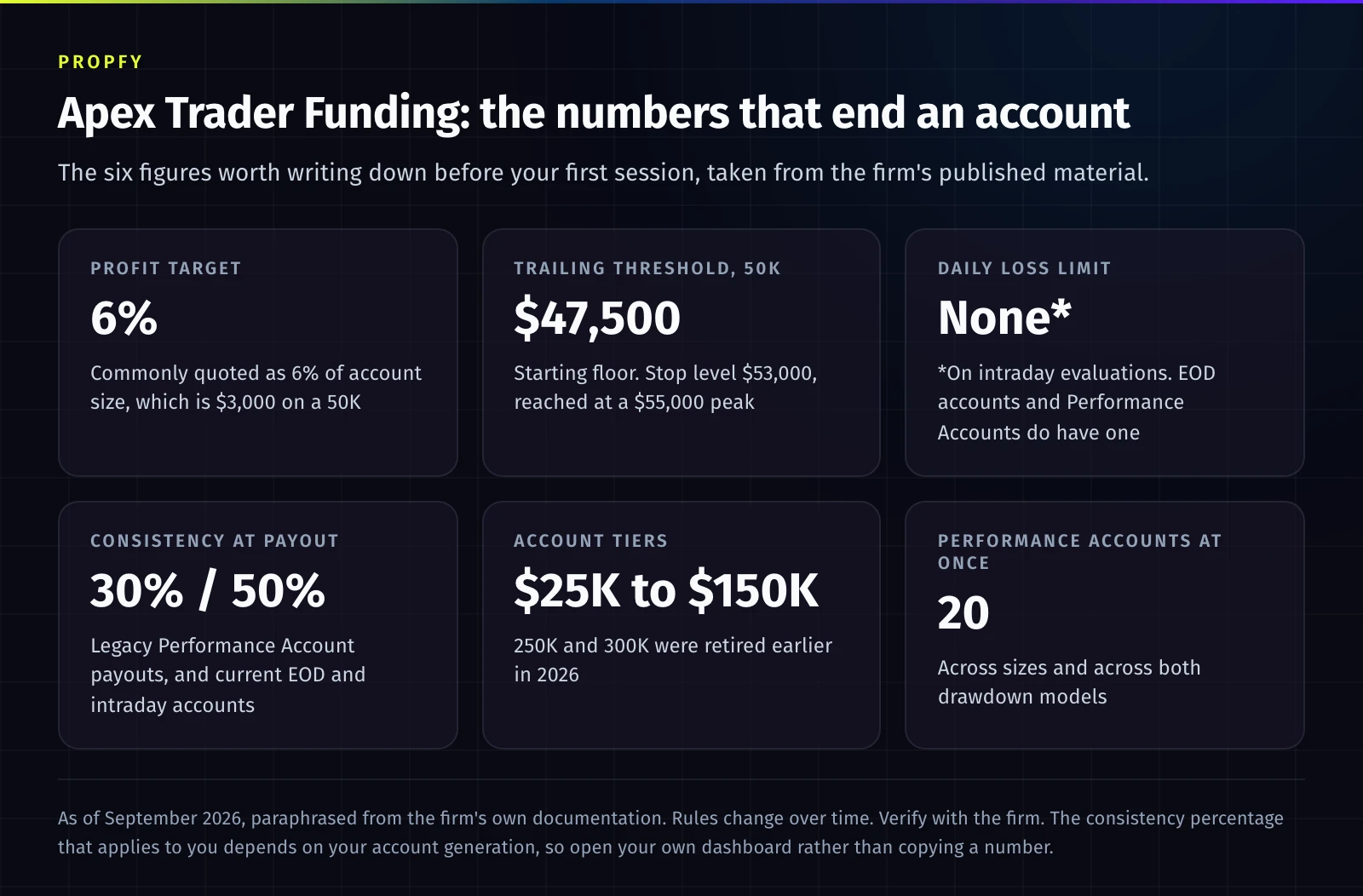
As of September 2026, Apex publishes evaluation tiers from $25,000 up to $150,000, having retired the 250K and 300K options earlier in the year. Profit targets are commonly quoted at 6% of account size, which puts the 50K target at $3,000.
| What to look up before you trade | Where it lives |
|---|---|
| Starting balance and profit target | Your account tier's evaluation page |
| Starting distance to the threshold | Same page, listed as max drawdown |
| Threshold lock level | The drawdown article for your model |
| Daily loss limit (EOD and PA only) | The daily loss limit article |
| Contract limit at your current tier | Scaling levels article for PAs |
That table is deliberately not filled in with numbers. Write yours in, from your own dashboard, on the day you start. A table you copied from a blog is a table you will misremember at 10:40am.
Multi-account rules and why they change risk tracking
Apex allows up to 20 Performance Accounts active at the same time, across sizes and across drawdown models.
Twenty accounts is not twenty times the opportunity. It is twenty thresholds, and if you copy one decision across all of them, it is still one decision. A trader running ten copied accounts who takes a marginal entry has not taken ten trades worth of risk analysis. They have taken one trade and multiplied the consequence.
The tracking problem follows: your behavioural sample is your decisions, and your risk exposure is your accounts, and those two numbers are different. If your journal counts copied fills as separate trades, your stats are diluted by a factor you never chose. That is the whole reason we built copy-trade handling into how Propfy counts a decision.
What actually ends an evaluation
In rough order of how often it happens:
- Touching the threshold. Usually not on a single catastrophic trade. Usually on the third or fourth trade of a session that was already going badly, taken because the account was down and the trader wanted it back.
- Not knowing where the threshold was. A version of the first, but worth separating. Peak balance including unrealized gains means the floor moved while you were in a winner you did not close. Traders who track their opening balance instead of their peak are working from a stale number.
- Rule breaks on the way to a payout. Consistency and the account-specific rules do not end an evaluation, but they can stall the money, which is the same disappointment at a slower speed.
Notice what is not on that list: being wrong about the market. Being wrong about the market is the job.
Why the rules matter more than the strategy
Here is one trader's data, and it is only one trader's, so treat it as illustration rather than evidence. Mo, who built Propfy, pulled his own numbers across a two-week live stretch. Win rate on trades taken after a win: 55%. Win rate on trades taken after a loss: 24%. Same model, same setups, same market. The only variable that changed was what happened immediately before the entry.
Trades nine through eleven in a day went 0%. Two sessions in that window landed near or past his self-imposed loss limit, one at minus $2,134.
If a similar split exists in your data, then the rule set is not an obstacle sitting between you and your edge. It is a description of your edge's operating conditions. Apex's threshold does not care whether your setup was valid. It cares about the balance. And the trades most likely to move that balance the wrong way are, statistically, the ones you take when you are already down.
That is the process-over-P&L argument in a sentence: a correct trade taken at a loss is a better trade than a win taken outside your model, because only one of those two is repeatable. Your journal is where you find out which kind you have been taking.
How to journal an account so the threshold is a number you already know
Four things to have on screen or on paper before each session:
- Distance to the threshold, right now. Not at the open. Now, after this morning's peak. On an intraday account, recompute after any trade that went meaningfully in your favour, whether or not you kept the profit.
- Distance to the daily loss limit, if your model has one, and to your own tighter number if it does not.
- Trade count so far today, with a cap you decided before the open.
- Whether the last trade was a loss. Flag it. If your own after-a-loss number is ugly, the next entry deserves a second look, or a break.
Then, after the session, one question per trade: was the setup present before I entered, yes or no. Log rule breaks separately from losses. They are different failures and they need different fixes. Our futures trading journal template has the fields laid out if you want to start on paper.
FAQ
Does the Apex trailing threshold include unrealized profit?
On the intraday model, yes. Apex documents the threshold following peak balance including unrealized gains, enforced continuously. On the EOD model the threshold is set from your end-of-day balance instead, so an intraday spike you do not close does not move it.
Is there a daily loss limit on Apex evaluations?
It depends on the model. Apex states there is no daily loss limit on intraday trailing drawdown evaluations. EOD accounts and Performance Accounts do have one, and hitting it liquidates open positions and pauses trading until the next session open rather than ending the account.
How many Apex accounts can I run at once?
Up to 20 Performance Accounts at the same time, across sizes and drawdown models. Verify the current cap with the firm, since account-count policies change.
Which consistency percentage applies to me?
Check your own account generation. Apex's help centre documents a 30% version tied to legacy Performance Account payouts and a 50% version for current EOD and intraday accounts. The rule applies at the payout request, not as an evaluation breach.
Sources checked (September 2026)
- Apex Trader Funding help centre
- Intraday Trailing Drawdown Explained
- EOD Drawdown Explained
- Daily Loss Limit Explained
About Propfy
Propfy is a trading journal for Apex Trader Funding, Topstep, and other futures prop firms. It syncs your fills or imports CSV, tracks your live distance to each account's drawdown floor and daily loss limit, records the rules you set and whether you followed them, and surfaces the behavioural splits (win rate after a loss, size after a loss, trades taken past your own cap) that a P&L-only journal will never show you.
It will not block a trade or close your platform, and nothing can promise you an outcome. What it does is put the number that ends accounts in front of you while there is still time to act on it.